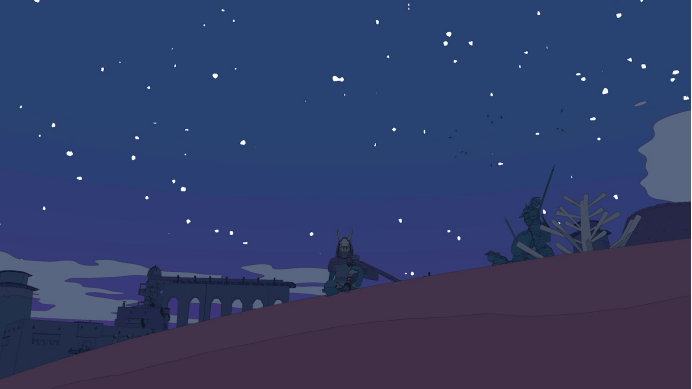
The moment the paint bucket was knocked over, the sound of the world disappeared before the color. It’s not silence, but a dull buzzing after everything’s soul is drained. I — an ordinary puppy named Pizza, was holding the phone and listening to the collapsed sobs of the painting master Chicory from the other end: “Color... The color is gone...” And on the other end of the phone, I used to be a bright green grass under my feet, and now there is only a gray and white. Then, the huge magic brush belonging to Chicory fell from the sky and hit me with a “bang”. The story of _Chicory_ begins with a color collapse, and the one who takes over the brush is an ordinary soul who has never felt special.
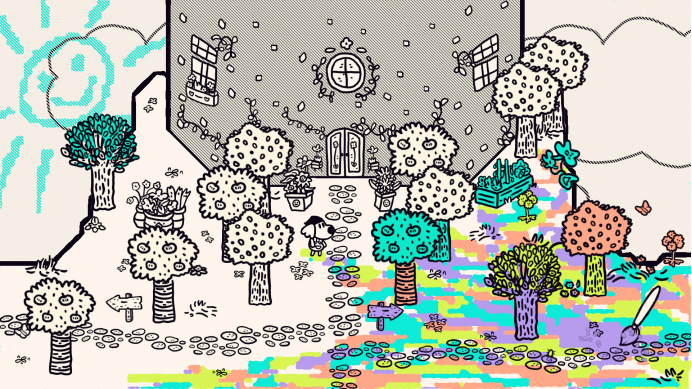
I picked up the brush. The pen shaft was taller than me, but when my claws held it, an unprecedented connection was created. Where the tip of the pen touches, the gray fades, and the color reappears like a heartbeat. However, the power given to me is not without weight. Chicory used to be the “color guardian” of the whole “painting kingdom”. She filled the world with color with her talent and brush, and therefore endured everyone’s expectations and scrutiny. Now she is missing, leaving behind a black-and-white world and a group of panicked animal residents, and I am just an ordinary puppy who is just her fan and works in the post office, but I have been pushed to the brush. What I have to face is not only the technical problem of restoring color, but also the great anxiety and self-doubt brought about by the identity of “inheriting the mantle of genius”: “Am I really worthy?”
The game turns the whole world into a huge and interactive canvas. I hold a brush in my hand and can freely color any object — grass, house, road sign, and even the clothes of the character. There is no “correct” color scheme, only my personal choice. Is it to restore the traditional lush greenery of the forest, or to paint it with dreamy purple? Do you paint your friend’s house with warm orange, or do you paint it with spots like a prank? This freedom is exciting at first, but then it brings a sense of responsibility: my aesthetics is permanently changing the world in the eyes of others. What’s more interesting is that color is not only a decoration, but also a tool for solving puzzles and exploration. Paint the dark cave with bright colors, and the hidden path will appear; inject color into the withered plants, and it will grow and build bridges. The brush is not a weapon, but a master key. Its power to solve problems directly comes from the “creation” behavior itself.
As the adventure progressed, I went deep into the areas eroded by “stains” (a black substance that devours color). These places are not only geographical difficulties, but also the projection of anxiety, pressure and perfectionism accumulated in the real world by the former guardian Chicory. What I want to fight against is not the monster, but the “depletion” itself. In the “Dinner Plate Forest”, the stain is expressed as a fear of mediocrity, which makes everything the same; in the “Brush Peak”, the stain is a severe self-criticism, turning into a sharp storm to block the way. The solution is not to fight, but to use a brush to understand, communicate and finally transform these emotions — draw calm lines for the whirlwind of self-criticism, and a brave light spot for the haze of fear. I’m not just cleaning up the stains, I’m walking step by step and healing the broken heart of the missing genius.
Along the way, I met all kinds of residents. They reacted differently to me, the “new guardian”: unconditional support, heavy expectations, and disdainful suspicion. Their conversation really touched the mind of the creator: what if the inspiration is exhausted? What if others don’t like my work? What if my talent is not as good as that of my predecessor after all? There is no standard answer to these dialogues, but they make me constantly reflect on my relationship with “creation” during the game. The game even sets up a mobile phone that can be answered at any time. Friends will call to chat, encourage or ask for help. These warm daily trifles have become anchor points against grand anxiety.
In the end, I did not save Chicory with the posture of a hero, but met her — the idol I looked up to, who was also a mortal crushed by the burden — at the source of all colors. Instead of an epic duel, we launched a dialogue about creation, responsibility and self-acknowledgement. She saw the world in my pen, which may not be “perfect” but full of vitality and personal imprint. The ending is not to return the brush, but a kind of co-governance, or even a liberation: color does not belong to a certain guardian, but belongs to everyone who is willing to pick up the brush and add a touch of real life to life.
After passing the game, I quit the game, but I felt that the color of the real world in front of me seemed to be more vivid. _Chicory_ tells me with its gentle brushstrokes like watercolor: art is not exclusive to genius, but the basic action of existence. When you are anxious that you are not good enough, perhaps the most important thing is not your skills, but whether you dare to make your brave first stroke on the gray and white canvas of the world. After all, what makes the world shine again is never a magic brush, but countless ordinary and precious souls like Pizza who still choose to graffiti in doubt.