When I pushed open the thick oak door, the first thing I saw was another me, pushing it open from the opposite door. Countless “I” extend to the end of vision in the reflection of countless mirrors. There is no front desk or waiter here, only a hotel called “Sea Monster”, and an anonymous letter inviting me to “solve the last puzzle”. The opening of _Lorelei and the Laser Eyes_ declares its essence with an infinite visual recursion: this is not a simple escape game, but a meta-reasoning of the narrative, memory and the identity of the creator itself.
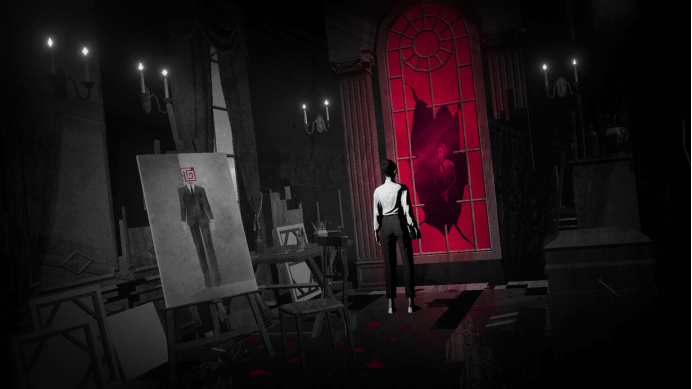
The hotel itself is a huge and living puzzle. The arrangement of the corridor is against the laws of physics, and the road we walked yesterday may led to a completely different room today. The portrait on the wall will change its expression as my perspective moves; a diary in the hall will be automatically updated according to the area I am currently exploring, as if it is being written by me in real time. The most disturbing thing is the sense of time — the clock in the hall always points to different moments, and when I pass through certain arches, the watch pointer will suddenly turn upside down or rotate rapidly. Here, the observation behavior itself is changing the object of observation. I’m not exploring a static space, but playing with an intelligent body composed of visual tricks and psychological hints.
The core of solving the puzzle is “building a connection”. I need to collect the fragments scattered everywhere: a blurry photo, a distorted recording, a torn page of script, and an unclear mathematical formula. These fragments are meaningless in themselves, but when I put them side by side, superimposed or viewed them through specific filters (such as a colored glass that can display hidden text), new information will emerge. For example, overlapping a photo of a corridor with an abstract painting may reveal the hidden room number; if you slow down the recording of a rain sound ten times, you will hear the Morse code encoded in it. The puzzle design is outrageous. It does not test my knowledge reserve, but whether I can break out of the routine and “recombine the world” with the logic of the game creator.
As the exploration deepened, I gradually realized that the structure of the hotel seemed to reflect a certain creative process. The east wing full of drama costumes and props is like the “character shaping” stage; the atrium full of architectural blueprints and models represents the “stage construction”; and the west wing full of editing machines and full of film burning smell is undoubtedly “editing and reconstruction”. The clue I encountered began to point to a director or writer named “S”, who seemed to be creating a film or novel about the hotel, and I myself seemed to be both an investigator of this work and a character who had been repeatedly modified. The boundary began to blur: am I solving the puzzle left by S, or playing the script that S wrote for me? Or, I may be S, looking for myself in lost works?
The climax of the game happened when I finally entered the “screening room”. There is no ultimate treasure, only rows of empty chairs and an old-fashioned projector that plays clips in a loop. The content of the clip is the key choice moment I experienced in the hotel, but it was shot from another perspective. The camera slowly turned to the empty audience, and finally fixed on the only figure sitting — it was a figure with his back to the screen and writing with his head down. When I approached, the figure dissipated, leaving behind an unfinished and ink-dried script on the seat. The last page was about my approach at this moment.
I didn’t get the “truth”, because the truth is the infinite, self-referring cycle itself. The hotel is the materialization of creative thinking, and my exploration is the process of thinking trying to understand itself. When I finally left, I returned to the main entrance of the hotel. Looking back, the oak door is still standing, but for some reason, I think it is both an end and a starting point for the next round of recursion.
After quitting the game for a long time, I will still subconsciously look for those small “inconsistencies” in life, as if reality is just another well-designed puzzle. _Lorelei and the Laser Eyes_ didn’t give me a story that could be summarized. It gave me a sense of dizziness. It makes me believe that the deepest puzzle may not be an organ hidden in the room, but the infinitely reflective mirror that we are bound to fall into when we try to understand any story (including our own story).