When the keel of The Vessel expedition ship was completely broken in the screams of the ice, time seemed to freeze together. We were trapped in the middle of the boundless white desert of Antarctica, the radio was silent, the hope of rescue was bleak, and the captain — our leader who followed the trail of the legendary explorer Destiny — disappeared in the disaster. As a critical deputy, what I took over was not the command, but a cold logbook, a group of crew members who were gradually falling into despair, and an increasingly clear understanding: we may not be able to wait for spring. _The Pale Beyond_ throws me into not only a survival test, but also a fragile experiment to maintain “humanity” in a desperate situation.
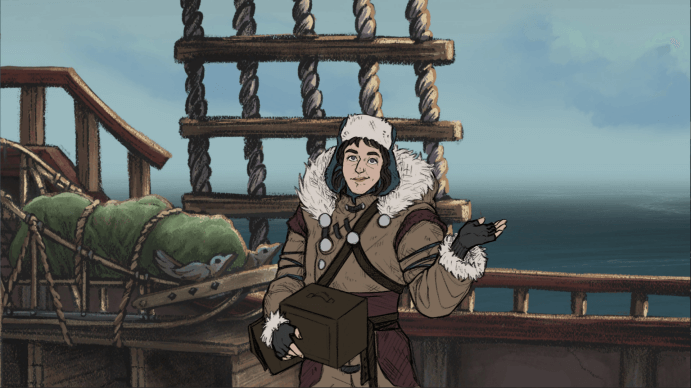
My every day begins with the distribution of rations. The numbers on the material panel are ruthlessly reduced: food, fuel, medicine, and even the “hope points” to maintain morale. Each crew member has a name, skills, physical condition and emotional state. The carpenter is good at maintenance but prone to depression, the doctor is calm but the leg injury is not healed, and the young scholar is full of enthusiasm but lacks physical strength. I not only have to decide who will hunt seals on the ice and who will repair the generator in the cabin, but also who can have a spoonful of precious stew tonight, and who should listen to the cry of the emotionally broken man. There is no perfect answer to these options: letting the depressed crew go to the dangerous field may be a disaster, but giving him a limited antidepressant means that another frozen crew member will have to endure more pain. Every assignment is to put another heavy weight on the balance of human nature.
The core of the game is “management”, but the object of management is far from resources. The undercurrent surged in the cabin: the shortage of materials caused suspicion, the rumors about the captain’s whereabouts gave rise to factions, and the long polar night eroded everyone’s reason. I will find anonymous accusations in the logbook, and I will hear two crew members whispering in the cargo hold late at night. As a leader, I must choose the way to intervene: whether to hold a full-member meeting openly and transparently (which may cause panic), or to talk to key people privately (which may be regarded as partial)? Is it to strictly enforce discipline, or to allow some minor violations to relieve the pressure? There is no clear “morality” in the game, but every decision weaves the crew’s trust or distrust of me, and these emotions will eventually converge into the collective will that determines life and death.
As time goes by, The Vessel itself has become a patient in need of care. The ice pressure may squeeze the hull again at any time, the snowstorm will block the vents, and the strange aurora will sometimes interfere with all electronic devices. Our original mission — to find the truth of Destiny — seems to be far away before survival, but it is the final meaning of supporting the spirit of some crew members. I had to assign the already scarce manpower to explore the strange signals or debris found in the distant ice field. These expeditions may bring back key parts or food, or may leave the elite team members without returning. Mission and survival have become the cruelest paradox at this moment.
The most profound thing about the game is how it presents “hope” as a renewable limited resource. An improvised concert, a ceremony to celebrate the little discovery, and even the fair distribution of the last bit of chocolate can temporarily boost morale. But hope will also be ruthlessly consumed: a failed hunt, the death of a companion, and another round of unanswered radio calls. My role as a conductor has gradually changed from a decision-maker to a distributor and guardian of “hope” — sometimes I even need to hide the cruel truth to maintain the string that is about to break.
In the end, the spring did not bring the rescue ship. What we are waiting for is the cracking of the ice, which is the final choice that must be made: whether to stay on the gradually sinking ship and wait for the faint miracle, or risk stepping on the dangerous sea ice and go to the unknown land? This choice does not have room for my personal heroism. It depends on whether I have successfully maintained this group of desperate individuals into a community that is still capable of action in the past dozens of difficult days and nights.
No matter what the ending was, when I finally closed the captain’s log full of scribbled decisions, death records and sporadic warm moments, what I felt was not victory or defeat, but a kind of exhaustion and relief. _The Pale Beyond_ does not provide the legend of survival. It only provides the rough, gray, and occasional texture of survival itself. It made me understand that on the other side of the desperate situation, leadership is not about rightness, but about trying to make the flame called “we” burn for one more day in countless “wrong” choices.